Staffing option years before they start
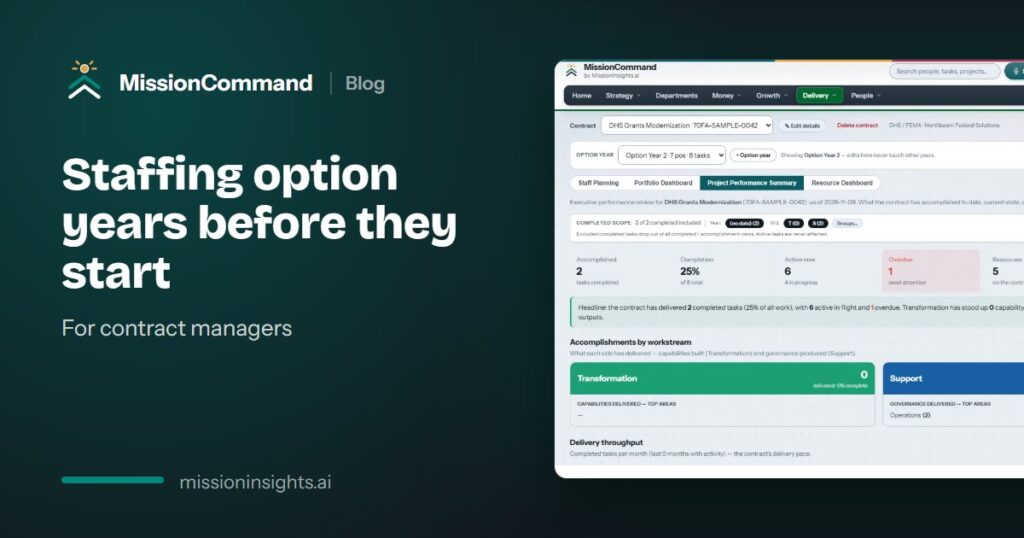
In a services contract, staffing is the cost, and each option year is its own staffing question. Yet in many small contractors the whole plan lives in one workbook that one person maintains. A new option year means copying it and hoping nothing breaks. The funding gap shows up when finance asks, not when a position changed.
Plan each option year on its own
Treat every option year as a separate plan with its own positions and tasks. When the next year comes up, clone the current one and adjust it, so a change to next year never quietly rewrites this one.
For each seat, record five things:
- The person, or that the seat is open.
- The labor category.
- The share of a full-time role.
- The rate.
- The section of the work statement it answers to.
That last item matters more than it looks. When a program manager asks why a seat exists, the answer is on the line.
Cost positions so burn is always current
If every position is costed from its rate, its FTE and its hours, monthly burn follows automatically. So does the funding gap: the difference between what the plan will spend and the funding available. The goal is to see the gap open the day a position changes, not at month end.
Hire against the open seat
An unfilled position is a recruiting job with a deadline. Raise the requisition from the seat itself and track candidates against it, so everyone can see which open seats have someone in the pipeline and which do not. Keep a resume bank with role, clearance level and skills, for candidates and current staff alike. It pays off again when a proposal needs key personnel.
Make the program review packet a by-product
Before every review, someone usually spends a day gathering task status, milestones and risks by hand, and an overdue item still slips through. If tasks are tracked by owner, option year and due date, the packet can be built from the tracker instead. Name overdue work, and the person carrying it, on the dashboards. A monthly status brief should cover an executive narrative, accomplishments, risks and the focus for the next period.
How MissionCommand handles it
Contract Management in MissionCommand holds a staffing plan and a task tracker for each contract, one option year at a time. You can import the staffing workbook or build it in place, then clone one option year into the next. Positions are costed from rate, FTE and hours, four dashboards are ready to share with a program manager, and the Reports tab turns the tracker into a status brief that prints or saves to PDF.
See it on the MissionCommand page for contract and program managers.