Running a scholarship cycle: applications, recommenders, committee review and renewals
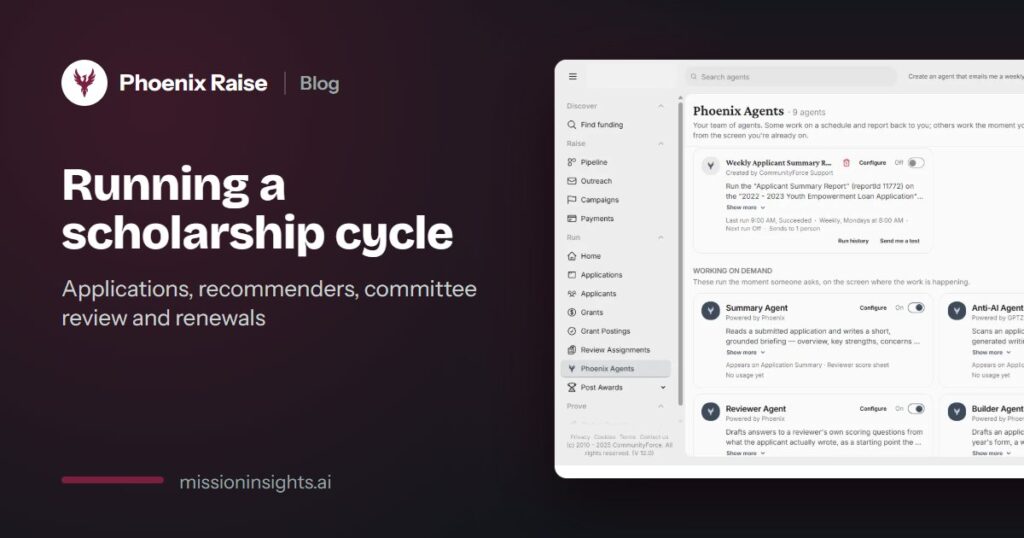
A scholarship cycle is several jobs in a row: collecting applications, chasing recommendation letters, getting a committee through a stack of essays, deciding which fund pays for which award, and then checking renewals for years afterwards. Most offices run each step in a different place. The cracks show up the week the committee meets.
Applications: ask only what each applicant needs
Long forms put off good applicants. Conditional logic helps: a question appears only when an earlier answer calls for it. Automated scoring can handle the parts of an application that are objective, and group applications let a team apply together when a program calls for it.
Recommenders: know which letters are still out
The classic failure is the week before committee, when nobody is sure which recommendations are missing and someone emails every recommender just in case. Run recommender requests as their own workflow, with a due date on each, and keep one report that shows every request as overdue or received.
Committee review: start from the essentials
Reviewers have a stack of narratives and little time. A plain-language summary of each applicant lets them start from the essentials and spend their reading time where it counts. Keep the decision with people: a summary should not score, rank or recommend anyone.
AI-written essays: a fair way to raise the question
Reviewers now wonder whether an essay was written with AI, and without a consistent approach the question gets raised unevenly. A fairer method is to flag passages that may be AI-written for the reviewer to weigh, as one data point. The flag should never be a verdict, never a score, and never shown to the applicant.
Awards by fund, and renewals that do not need a spreadsheet
Awards usually come from many funds, each with its own budget. Put the information for each applicant on one row: review scores, the automated score, the amount requested, and the initial and final award. Add whether the award is renewable, for how many years, and the next renewal date, so renewals are checked from one table rather than by hand each year.
Show donors what they funded
Scholarship funds often come from donors who want to know what their gift made possible. A short impact report by fund and academic year closes that loop. Skip donors who have unsubscribed, and log every send.
How Phoenix Raise handles it
Phoenix Raise handles scholarship and fellowship applications, recommender letters, committee review, awards by fund and renewals in one place. The Summary Agent writes a plain-language overview of each applicant and never scores or ranks, the Anti-AI Agent flags possible AI writing for reviewers only, and Award Allocation by Fund shows each award and its renewal on one row. Phoenix Raise is FERPA compliant and Section 508 accessible, and customer data is never used to train AI models.
See it on the Phoenix Raise page for university scholarship offices.