A weighted pipeline you can defend: gate reviews for small capture teams
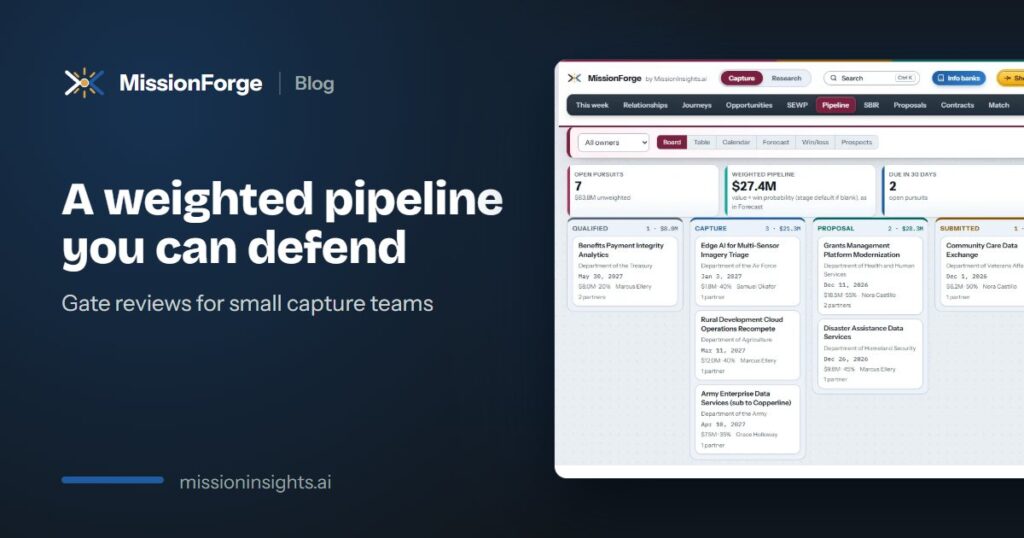
Ask a small capture team for its weighted pipeline and you will usually get a number. Ask which of those pursuits the company actually decided to bid, and the room goes quiet. The forecast is only as honest as the decisions behind it, and in most small firms those decisions are never written down.
Why the forecast turns into a hopeful number
Pursuits drift. One week an opportunity is qualified, a few weeks later someone has started on the proposal, and at no point did anyone say “yes, we are bidding this.” When leadership asks for a weighted figure, nobody is sure which deals were ever really chosen. The number goes up, and so does the risk that it means nothing.
Large primes solve this with formal gate reviews. A team of five can use the same idea, as long as it stays light enough to keep using.
Four gates between qualified and submitted
A gate is a short, scored review that a pursuit must pass before it moves to the next stage. Keep the criteria on a weighted scorecard, and let the team change the criteria as it learns what predicts a win. The point is not paperwork. It is that every pursuit in the proposal column got there because someone decided it should.
Then make skipped gates visible. A pursuit that moved on without its review should stand out on the forecast before the pipeline call, not after the bid is lost.
One board, from qualified to won
Put every pursuit in one of six columns: Qualified, Capture, Proposal, Submitted, Won and Lost. Each card should carry four things: its value, its chance of winning, its owner and its partners. With those four on the card, a weekly call can move quickly. Switch to a table when you need to sort, or a calendar when you need to see which deadlines land in the same stretch.
Stop starting every proposal from a blank page
The other drain on a small team is the proposal itself. Past proposals, resumes and case studies sit in folders nobody can find under a deadline, and the red team date arrives before the compliance matrix does. A steadier routine is:
- Shred the solicitation into a compliance matrix first.
- Build the outline in the RFP’s own order.
- Draft each section from your own record: past proposals, case studies and resumes.
- Have a person approve every section, and keep a checklist that must be complete before anything is marked submitted.
How MissionForge handles it
MissionForge gives a small capture team the gate reviews, forecast and proposal workspace that large primes run, sized for a team of five. Every pursuit passes four gate reviews on a weighted scorecard you can edit, and the forecast lists any pursuit that moved on without its gate. Claude drafts proposal sections from your own documents, a person approves each one, and nothing is marked submitted until the checklist is complete.
See it on the MissionForge page for capture and BD leads, or explore the free sample company.