Cash forecasting for government contractors: contracts, payroll and overhead
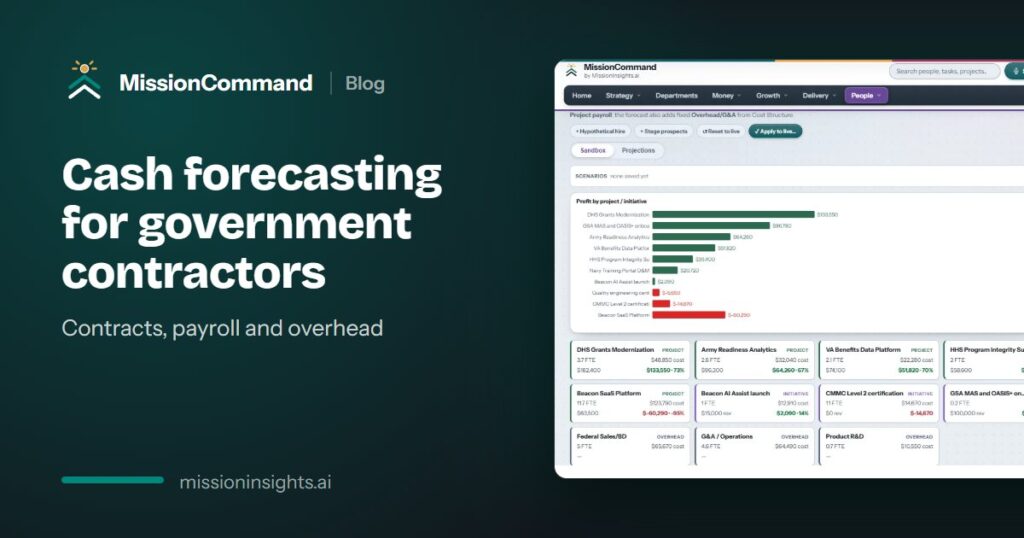
For a government contractor, cash usually turns months after the thing that caused it. A contract ends and costs step up, but the bank balance only bends later. By the time it shows on a statement, the time to act has passed. A forecast built from the right inputs moves that warning forward to the month the decision is made.
Start from the latest actual balance
Begin with your most recent actual bank balance, and mark each month-end balance as actual once it closes so it stays fixed. Everything after that point is a projection, and it should be clear on the page which is which.
Build each month from four inputs
- Contract timelines. When each contract and option year starts and ends, and what it brings in.
- Payroll. The people you have, and the people the staffing plan says you will have.
- Overhead. The costs that do not move with any one contract.
- Debt service. What leaves the account each month to lenders.
Keep the forecast tied to the plan
The most common failure is drift. Someone changes the staffing plan, nobody updates the forecast, and the board pack is built on last month’s assumptions. The fix is structural: the forecast and the staffing plan should read from the same numbers, so a change in one is a change in the other.
Set a cash target and test the pipeline against it
A target turns a forecast into a decision tool. Show the date you reach it, the monthly run-rate needed to get there, and every month that would run at a loss. Then test what the pipeline could do: what a deal in negotiation would add if it closed, or what a late award would cost if it slipped. Run those as simulations, so the real opportunity record does not change while you think.
For the pipeline itself, weight each opportunity by a default chance of closing for its stage, allow an override on any pursuit, and keep early lead generation out of the weighted figure.
Decide the order of cuts before you need them
If cash tightens, a pre-agreed order saves an argument. One sensible order is discretionary cost first, then non-billable contractors, then non-billable staff, then deferrable initiatives. Billable labor stays off the list, because it is what brings the cash in.
How MissionCommand handles it
MissionCommand projects cash month by month from contract timelines, payroll, overhead and debt service, starting from your latest actual balance, and it is the same model behind every screen. The proforma, cash target, win and slip simulators, valuation and break-even plan sit in one place that only administrators and executives can see. Read more on the MissionCommand page for CFOs, or explore the free sample company.